Overview
Module: Module 4: Local Voice Assistant
Topic: 02: Whisper, Piper & Wyoming
Activity type: Reading / reference (Learn)
Bloom focus: Apply / Evaluate
Links to outcome: Given CPU/RAM constraints, the learner can deploy local Whisper (STT) and Piper (TTS) via Wyoming, benchmark them separately, and record latency/quality tradeoffs before integration.
Why this matters
Voice feels ‘AI magic’ until a tiny host thrashes. Separate STT/TTS proof prevents false blame on Home Assistant or the satellite.
Vocabulary
Add terms as you encounter them in Instruction.
Core reading
Architecture
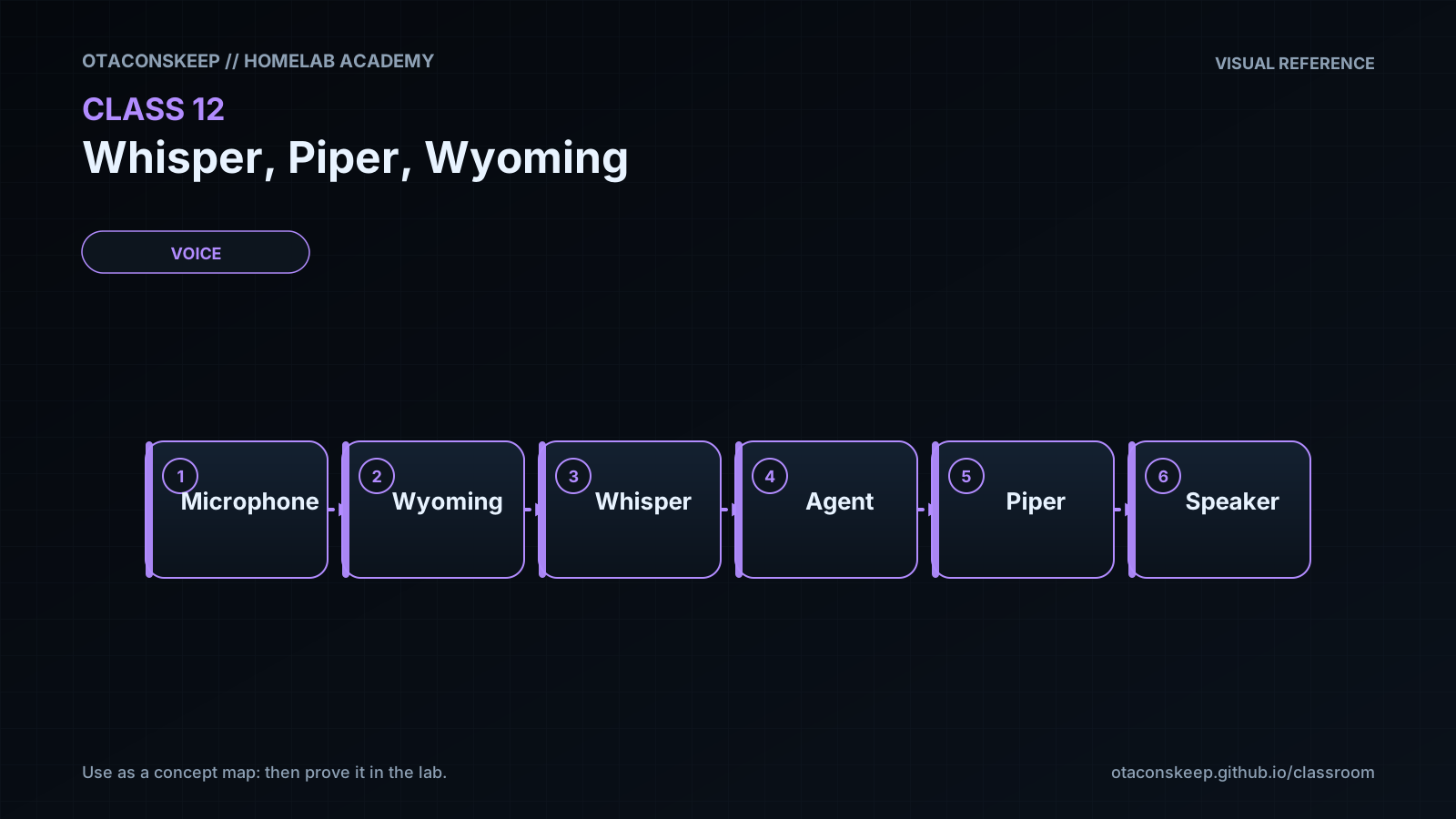
Whisper provides speech recognition. Piper provides speech synthesis. Wyoming is a protocol used to connect compatible voice services and satellites. Home Assistant orchestrates the Assist pipeline.
flowchart TD
    A["Captured audio"] --> W["Whisper STT"]
    W -->|"text"| H["Home Assistant Assist"]
    H -->|"response text"| P["Piper TTS"]
    P --> O["Audio output"]
    Y["Wyoming protocol"] --- W
    Y --- P
These are distinct services. A Wyoming endpoint being reachable does not prove the model is loaded, the language is correct, or the audio is good.
Compute and model tradeoffs
Larger STT models can improve recognition but cost memory and latency. CPU-only inference may be acceptable for short commands but slow for conversation. GPU acceleration adds drivers, device access, model compatibility, and resource competition. Establish a baseline before optimizing.
Record:
- STT model and language.
- Compute device.
- Cold and warm latency.
- Test phrase accuracy.
- Real-time factor if available.
- Concurrent-request behavior.
Piper voices have language, speaker, sample-rate, and voice-model characteristics. A voice file and matching metadata/config must remain paired. Voice tuning can change speed and variation; test intelligibility before personality.
Network contract
For every Wyoming service, record host/service name, port, network path, protocol role, health method, model/voice, and logs location. Do not publish voice-service ports to the public internet.
Test layers:
DNS -> TCP port -> Wyoming handshake/discovery -> model load -> inference -> output quality
Resource contention test
- STT baseline idle
- STT while LLM generating (if present)
- TTS baseline
- TTS during STT
# Host pressure snapshot while testing:
free -h
uptime
docker stats --no-stream
Get-Process | Sort-Object CPU -Descending | Select-Object -First 10
docker stats --no-stream
Record latency, memory, errors, thermal/fan behavior.
Worked example (study this)
I do: study the reasoning, not just the final answer.
Bad: Wire wake→STT→HA→TTS→speaker on day one with the biggest model.
Better: Prove STT with a known sentence; prove TTS with a known phrase; measure resource contention; only then integrate.
Projects, repositories, add-ons, and model backends change. Use the current Home Assistant integration/add-on guidance and currently maintained Piper/Whisper implementations. Do not follow an old image name or abandoned repository solely because a video shows it.
Next
- Open the Lesson for prior-knowledge check, guided practice, and required Feynman teach-back.
- Then complete Lab, Homework, and Quiz for this topic.