Overview
Module: Module 4: Local Voice Assistant
Topic: 03: Private smart speaker
Activity type: Reading / reference (Learn)
Bloom focus: Create / Evaluate
Links to outcome: Given working STT/TTS providers, the learner can integrate wake → action → spoken response and prove an internet-disconnected end-to-end pass with staged gates.
Why this matters
Integrate a voice satellite, wake-word engine, VAD/audio transport, Whisper, Home Assistant Assist, local intent or conversation processing, Piper, and speaker playback. The final privacy requirement is demonstrated behavior under WAN disconnection, not a marketing label.
Vocabulary
Add terms as you encounter them in Instruction.
Core reading
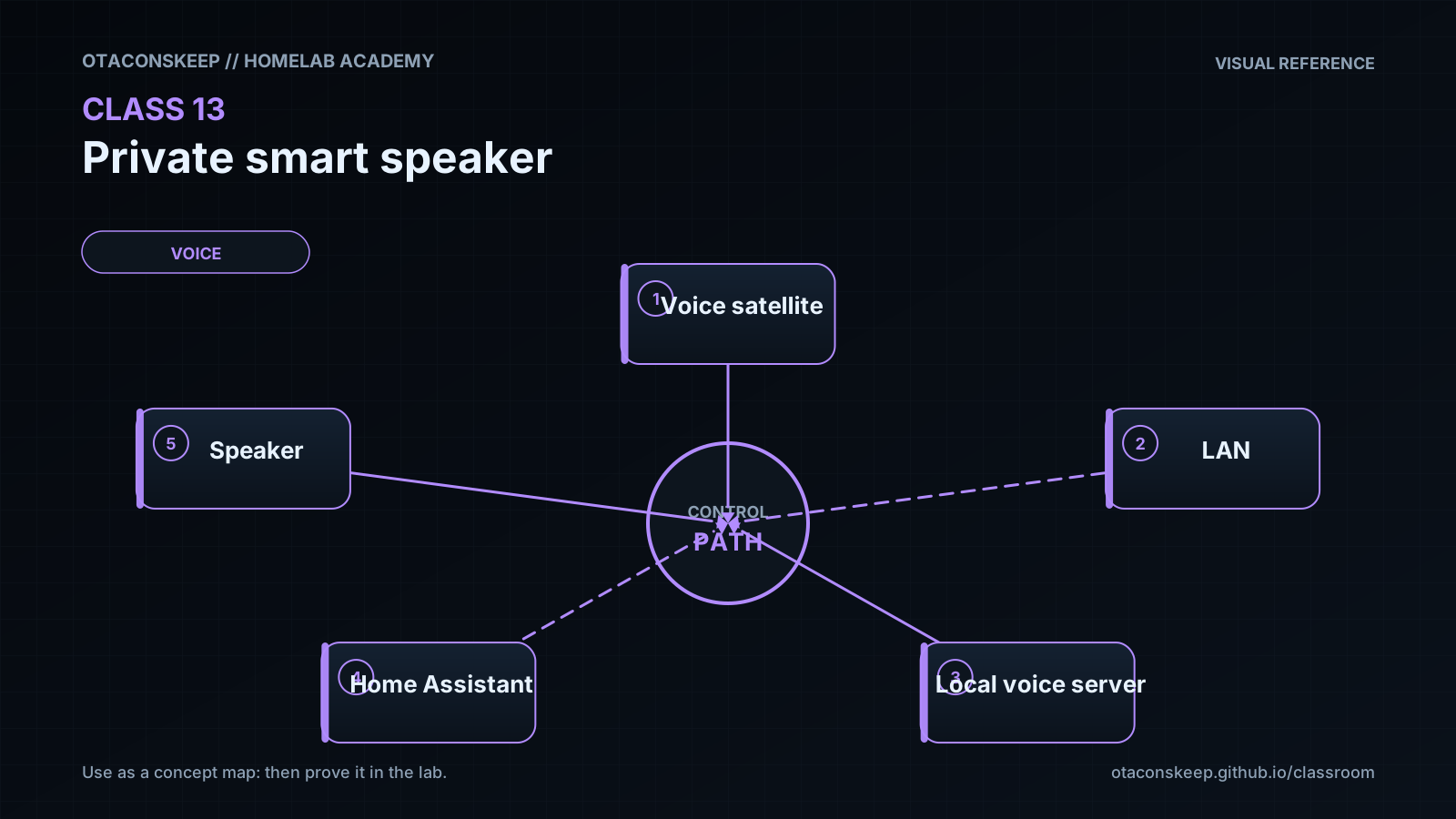
System boundary
flowchart TD
    S["Satellite mic + speaker"] --> W["Wake word + capture"]
    W --> STT["Local Whisper"]
    STT --> HA["Home Assistant Assist"]
    HA --> E["Local entity/action"]
    HA --> TTS["Local Piper"]
    TTS --> S
Optional local LLM conversation belongs behind a routing decision. Deterministic home-control commands should not require an open-ended model unless the design explicitly accepts the latency and failure modes.
Satellite responsibilities
Depending on hardware/software, the satellite may handle microphone capture, wake word, VAD, audio streaming, playback, LED state, and local buttons. Record where each responsibility executes; otherwise failures are impossible to localize.
Example responsibility map:
| Function | Location |
|---|---|
| Microphone capture | Satellite |
| Wake word | Satellite or central service, choose and record |
| STT | Local server |
| Intent/action | Home Assistant |
| LLM, if used | Local compute node |
| TTS | Local server |
| Playback | Satellite |
Progressive integration gates
Do not skip gates:
Gate A: audio hardware
Record and play a known sample locally. Validate device selection, gain, clipping, channels, sample rate, echo, and speaker route.
Gate B: wake word
Run repeated positive and negative trials. Record threshold/model and test distance.
Gate C: STT
Prove the known sentence transcript. Preserve captured audio for comparison.
Gate D: HA understanding
Enter transcript as text. Confirm correct intent, area, entity, and action.
Gate E: action
Confirm entity reaches the requested state and record HA trace/log.
Gate F: TTS and playback
Synthesize a fixed response and play it through the satellite.
Gate G: end to end
Speak wake word and command. Capture timestamps at wake, end-of-speech, transcript, intent, state change, synthesis, and playback.
Gate H: offline privacy
Disconnect WAN access while preserving the LAN. Repeat the full command and a second informational command that is defined as local. Verify DNS or cloud dependencies do not silently block the pipeline.
Local LLM routing
If you add an LLM, whitelist only low-risk intents. Lights/locks/garage need deterministic intents, not open-ended chat.
Reliability and recovery
Document restart order: network → HA → Wyoming STT/TTS → satellite. Keep a known-good backup of HA and satellite config.
Worked example (study this)
I do: study the reasoning, not just the final answer.
Bad acceptance: “It worked once while Wi-Fi was up.”
Better: Progressive gates: wake only → STT → intent/action → TTS → full path: then repeat with internet disconnected and record the pass.
Use the lecture as a system-integration example. Hardware support, satellites, add-ons, repositories, and Home Assistant pipeline screens change. Current official documentation and the staged acceptance tests in this class govern the build.
Next
- Open the Lesson for prior-knowledge check, guided practice, and required Feynman teach-back.
- Then complete Lab, Homework, and Quiz for this topic.