Overview
Module: Download Clients & Indexers
Activity type: Lesson (Orient → Recall → Learn → Explain → Reflect)
Learning objective: Differentiate a Usenet indexer, Usenet provider, torrent indexer, BitTorrent tracker, download client, and automation application.
Bloom level: Understand / Apply
Last reviewed: 2025-03-08
Learning objective
Differentiate a Usenet indexer, Usenet provider, torrent indexer, BitTorrent tracker, download client, and automation application.
Why this matters
Teach learners to distinguish content-discovery services from transfer infrastructure, understand how Usenet and BitTorrent components interact, evaluate provider and indexer requirements, and design a secure automation workflow without contacting real indexers, trackers, peers, or Usenet servers.
Learn
Complete the module reading first:
Feynman teach-back: required
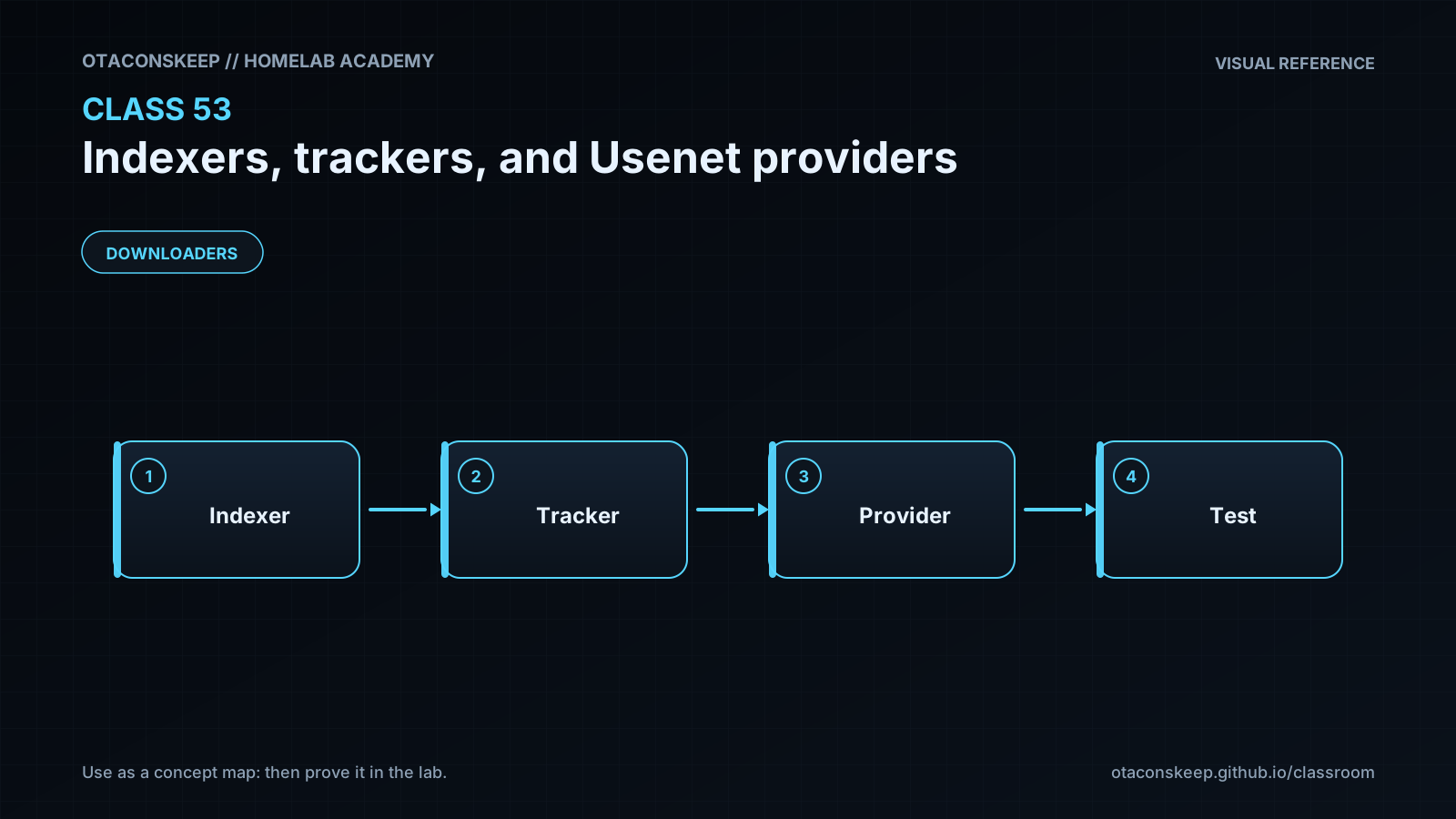
Explain the system to a new administrator using a library analogy. The indexer is the searchable catalog, not the shelf holding the material. An NZB or torrent metadata result is like a retrieval slip describing what is needed. A Usenet provider is the infrastructure from which an NNTP client requests referenced articles. In BitTorrent, peers exchange pieces, while a tracker can help participants find one another. The automation application is the coordinator that searches the catalog and hands a selected result to the correct client. If your explanation claims that a tracker stores every payload, that an indexer performs all transfers, or that an NZB is the final payload, revise it until each responsibility and trust boundary is distinct.
Answers save in this browser (localStorage). Completing all five fields is part of the mastery unlock.
Reflection
- What did I learn?
- What did I struggle with?
- How does this connect to earlier classes?