Overview
Module: Sonarr & Radarr
Activity type: Lesson (Orient → Recall → Learn → Explain → Reflect)
Learning objective: Explain Radarr's role in a media automation architecture
Bloom level: Understand / Apply
Last reviewed: 2025-03-08
Learning objective
Explain Radarr's role in a media automation architecture
Why this matters
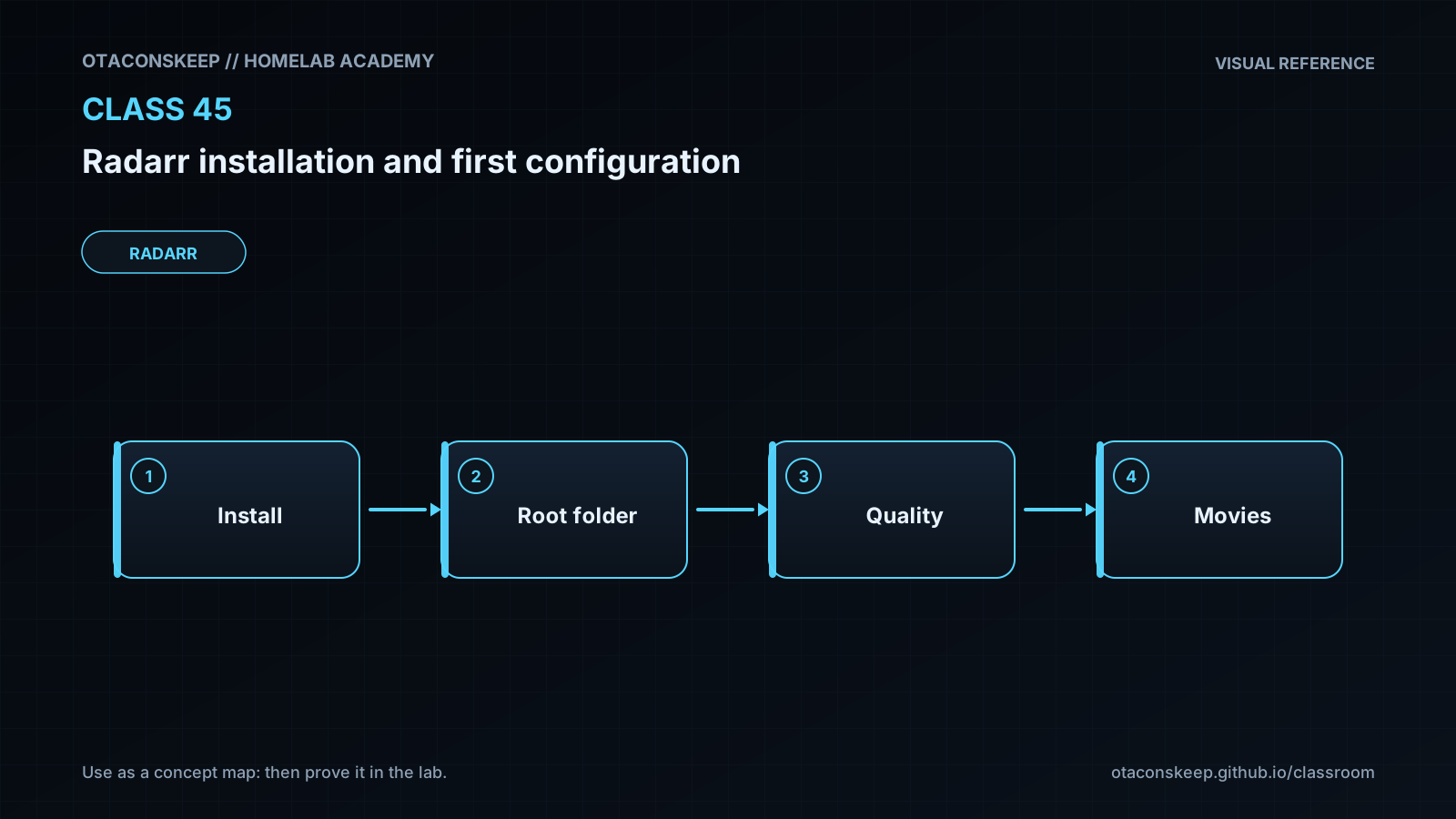
Install Radarr as a containerized service, create persistent application and media directories, complete the initial web configuration, and understand how Radarr coordinates movie monitoring, indexers, download clients, and media imports.
Learn
Complete the module reading first:
Feynman teach-back: required
Explain Radarr as if teaching someone who has never used media automation: Radarr is the coordinator, not the downloader. A user tells it which movie is wanted and what quality is acceptable. Radarr asks an indexer what releases exist, chooses an allowed release, and gives that request to a download client. When the download client finishes, Radarr needs to see the same completed file path so it can import the file into the organized movie library. In this lab, /config remembers Radarr's settings, /downloads is the staging area, and /movies is the final library. If /config is not persistent, Radarr forgets its setup. If /downloads is not consistently mapped, imports fail. If /movies is not writable, Radarr cannot organize the library.
Answers save in this browser (localStorage). Completing all five fields is part of the mastery unlock.
Reflection
- What did I learn?
- What did I struggle with?
- How does this connect to earlier classes?